Interpolation of data distribution
Interpolate between Point Clouds in the Wasserstein space
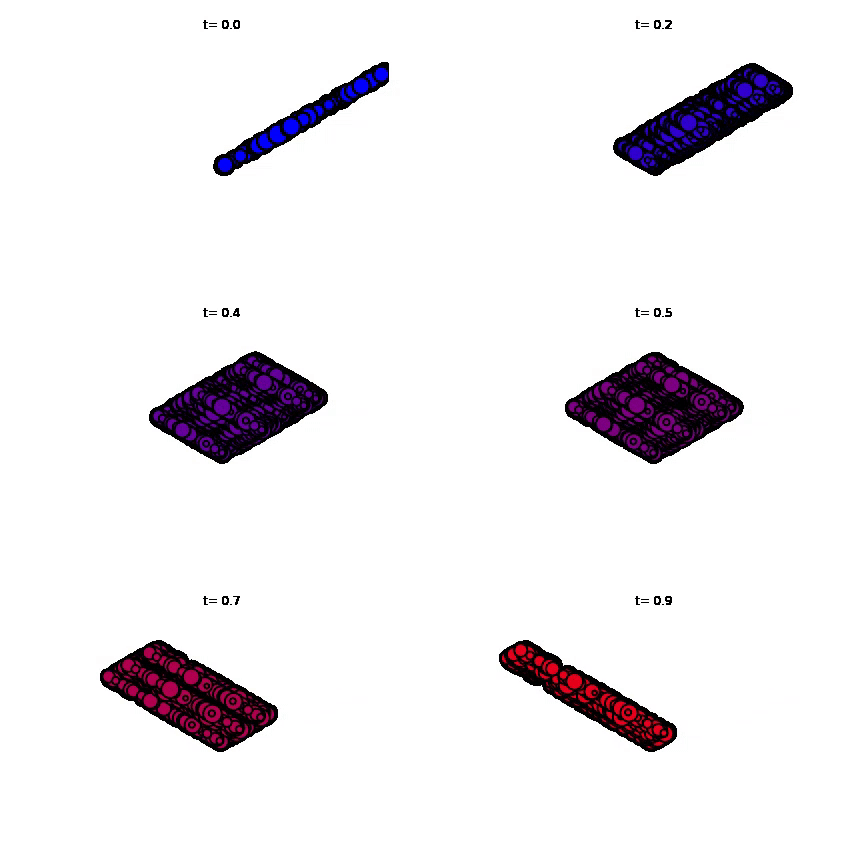

Tyler, an undergraduate at Dartmouth College, set out to truly grasp the concept of Wasserstein interpolation. Although this idea is far from new, it remains a fascinating and subtle phenomenon.
Given two measures $\mu_1$ and $\mu_2$, one may define the Wasserstein interpolation through either a given optimal transport map $T$:
\begin{equation} \label{eq:Wass_int_map} \mu_t = ((1-t)x+tT(x))_{\sharp}\mu_1; \end{equation}
or a given optimal transport plan $P$:
\begin{equation} \label{eq:Wass_int_plan} \mu_t = ((1-t)x+ty)_{\sharp} P. \end{equation}
As the animations above illustrate, it can behave in surprisingly unstable ways, at least in numerical experiments.
Consider two pairs of point clouds — blue at time 0 and red at time 1. In the top figure, the two clouds meet at a perfect right angle (90°), while in the bottom figure, the angle is slightly perturbed to 84.55°. Despite the small geometric difference, their Wasserstein interpolations diverge dramatically: the left one deforms smoothly, like kneading soft dough, whereas the right one almost performs a rigid rotation — more like a spinning baguette than a loaf being reshaped.
This contrast reveals both the beauty and the complexity of the Wasserstein interpolation. Optimal transport theory provides a partial explanation, yet a full understanding remains elusive — especially when we aim for predictable and controllable interpolations in practical applications.
Our current implementation owes much to Prof. Peyré’s excellent open-source experiments [1], particularly his formulation of optimal transport via linear programming. Moving forward, we plan to experiment with faster modern solvers [2] and explore more general multi-marginal OT (MMOT) frameworks [3] to push these ideas further.